
Watering and Fertilizing Bonsai Trees: Bonsai beautification begins with basic but vital care. You see, watering doesn’t just quench your bonsai’s thirst; it guards against both dehydration and over-hydration, which can lead to root rot.
However, hydration isn’t enough. Your bonsai tree requires a balanced diet, provided by fertilizer, to flourish. Nutrients like nitrogen, phosphorus, and potassium, often missing in the soil, are reintroduced through fertilization, promoting healthy growth and vibrant foliage.
So, what are the best techniques for watering and fertilizing these delicate plants and how often should they be applied? Let’s explore together.
Understanding Bonsai Tree Hydration and Watering and Fertilizing Bonsai Trees

To properly care for your Bonsai tree, it’s crucial to understand its hydration needs as watering plays a vital role in its growth and overall health. Over or under-watering your tree can lead to serious issues like root rot or stress. It’s a delicate balance, but one you can manage with some knowledge and attention.
Watering needs vary greatly among Bonsai trees depending on factors like climate, tree species, pot size, and soil composition. You can’t rely on a one-size-fits-all approach here. Instead, it’s essential to keep an eye on the soil moisture levels to prevent dehydration or waterlogging.
Consistent watering is key for maintaining the health and vitality of your Bonsai tree. It’s not just about the quantity of water, but also the consistency of watering. Inconsistencies in watering can lead to fluctuations in hydration, causing undue stress to your tree.
Importance of Correct Watering Techniques
Mastering the right watering techniques is essential for your Bonsai tree’s health and growth, as it ensures proper hydration, supports nutrient absorption and helps maintain a balanced root environment. Correctly watering your Bonsai doesn’t merely mean giving it water. Instead, it involves understanding its specific needs, observing soil moisture levels, and adjusting watering frequency accordingly.
Overwatering can cause root rot while underwatering can lead to dehydration. Both extremes can severely impact your Bonsai tree’s vitality. To prevent this, you must monitor and control the watering process carefully.
Let’s delve deeper. Here’s a straightforward table to illustrate the significance of correct watering techniques.
| Issue | Solution |
|---|---|
| Overwatering | Causes root rot. Monitor soil moisture levels and adjust the watering frequency. |
| Underwatering | Can lead to dehydration. Ensure adequate hydration by watering as per the tree’s needs. |
| Inconsistent watering | Affects nutrient absorption. Maintain consistent watering to support the tree’s metabolic processes. |
| Irregular soil moisture | Disrupts root environment. Regulate soil moisture to maintain a balanced root environment. |
Basics of Fertilizing Bonsai Trees

Just as watering plays a critical role in your Bonsai tree’s health, so does fertilizing, as it supplies the tree with essential nutrients like Nitrogen, Phosphorus, and Potassium for robust growth. Fertilizing your Bonsai tree ensures strong growth and a balanced development of its root system.
Understanding the NPK ratio in your Bonsai fertilizer is essential. This ratio indicates the proportion of Nitrogen (N), Phosphorus (P), and Potassium (K) in the fertilizer. Each nutrient plays a different role in your tree’s health, influencing everything from the strength of the branches to the vibrancy of the leaves.
The fertilization process isn’t just about scattering some granules on the soil surface. You need to consider:
- The type of fertilizer: Organic fertilizers often provide a slow, steady supply of nutrients, promoting balanced growth.
- The growth stage of your tree: Fertilizing requirements vary from the early development stage to the refinement stage.
- The application technique: Proper technique ensures nutrients reach the root system effectively.
Role of Nutrients in Bonsai Health
Diving into the heart of Bonsai health, it’s vital to understand that the nutrients from fertilizers, such as Nitrogen, Phosphorus, and Potassium, play a significant role in supporting the overall vitality and growth of your Bonsai tree. With proper fertilization, you ensure balanced nutrient uptake, benefiting not only the tree’s physical growth but also its ability to resist diseases.
| Nutrient | Role in Bonsai Health | Signs of Deficiency |
|---|---|---|
| Nitrogen | Promotes vigorous growth and healthy foliage | Stunted growth, yellow leaves |
| Phosphorus | Supports root development, flowering, and fruiting | Slow growth, small leaves |
| Potassium | Strengthens plant, aids in resistance to diseases | Weak stems, poor resistance to diseases |
Lack of nutrients can lead to stunted growth and yellowing leaves, signs of an unhealthy Bonsai. It’s crucial in Bonsai care to replenish soil nutrients through fertilization, promoting robust growth and development. Remember, a well-fed Bonsai is more likely to thrive, producing lush, vibrant foliage. So, don’t underestimate the power of a balanced fertilizer in maintaining your Bonsai’s health and longevity.
Timing and Frequency of Fertilization
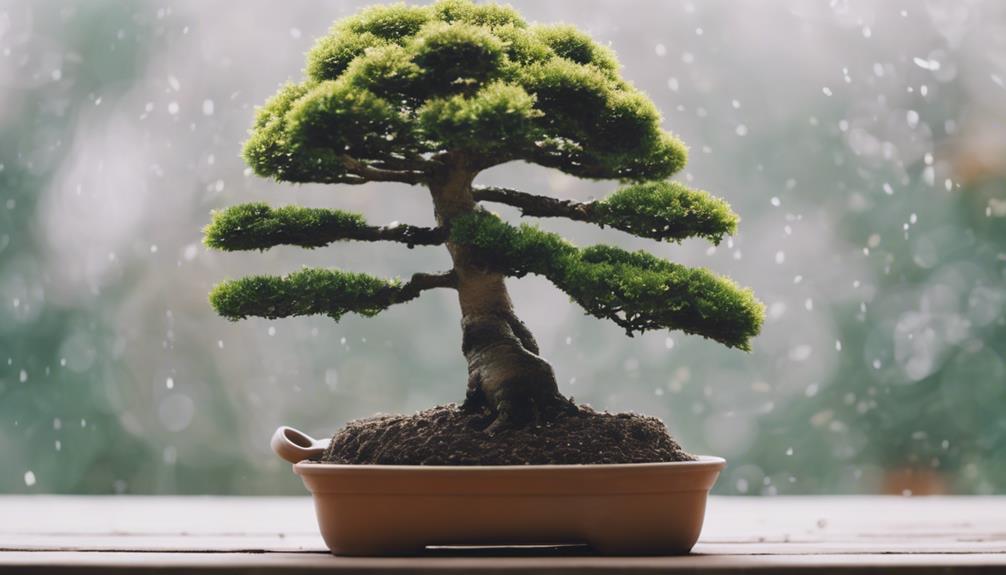
Understanding when and how often to fertilize your Bonsai tree is as crucial as choosing the right nutrients for its health and growth. Proper fertilization is vital for Bonsai growth; it helps extend their root system and strengthens their overall health. Leading Bonsai experts suggest that you should start fertilizing from early spring until mid-fall. This is throughout the growing season when your Bonsai needs nutrients the most.
There are specific tree considerations to take into account, too. For example, older Bonsai trees require less frequent fertilization. Indoor Bonsai trees, on the other hand, can be fertilized all year round to support their growth.
Here are key points to remember:
- Your first application of fertilizer should be well-balanced, with equal NPK ratios. This provides a good nutrient base for your tree.
- Organic fertilizers are generally better since they release nutrients at different times, ensuring a steady supply.
- Always adjust your fertilizing schedule based on the climate and the specific needs of your tree.
Conclusion
So, you see, properly watering and fertilizing your bonsai trees isn’t just routine maintenance. It’s vital for their overall health and longevity.
Correct watering avoids dehydration and waterlogging, while fertilization replenishes essential nutrients. Understanding the significance of these practices and their timing can transform your bonsai tree care, promoting vibrant growth and foliage.
In the end, it’s all about providing the best care possible for your little living art pieces.